
Rajasthan has become a serious option for new factories. Land is available in planned industrial areas, the state is on the Delhi–Mumbai corridor, and approvals now run through a single window. Still, many first-time entrepreneurs lose months because they apply for things in the wrong order. This practical checklist explains how to plan setting up a manufacturing unit in Rajasthan, step by step, so you can move from idea to first production with fewer surprises.
1. Start with the product, market and project report
Before you look at land, be clear about what you will make, who will buy it and at what volume. A detailed project report (DPR) should cover the product mix, installed capacity, machinery list, manpower, raw material sources, power and water needs, and a five-year cash-flow projection. Banks, investors and government departments will all ask for these numbers, so a realistic DPR saves time later.
Keep the first plan modest. It is easier to add a second line once orders are steady than to carry the interest on idle machines.
2. Choose the location and land
Most units in the state are set up in RIICO industrial areas, because the land is already zoned for industry and has roads, power lines and water nearby. Private agricultural land can also be used, but it must be converted for industrial use, which adds time. When you compare sites, check:
- Distance to raw material and to your main buyers
- Availability of power load and water supply
- Road access for trucks and, if needed, rail or ICD links
- Local labour availability and housing
- Whether the area allows your category of industry (some areas restrict polluting units)
3. Register the business
Decide the legal structure first – proprietorship, partnership, LLP or private limited company – because licences are issued in the name of that entity. Then complete the basic registrations:
- PAN and bank account of the entity
- Udyam Registration for MSME status, which helps with priority-sector lending and several schemes
- GST registration for buying inputs and selling with input tax credit
- Shops and establishment or labour registrations as applicable
4. Plan approvals through the single window
Rajasthan’s single window system lets you apply for many state clearances online and track them in one place. The approvals a typical factory needs include building plan approval, factory licence under the Factories Act (when you cross the worker threshold), fire NOC, and Consent to Establish and later Consent to Operate from the Rajasthan State Pollution Control Board. Your industry category decides how strict the pollution conditions are.
The state’s MSME facilitation law also allows new micro, small and medium units to start on a self-declaration and receive an acknowledgement, with many inspections deferred for an initial period. Check the current rules on the official portal before you rely on this, because conditions apply.
5. Arrange power, water and utilities
Apply for the electricity connection early, because a high-tension connection may need a new transformer or line. Ask the distribution company about the load sanction process and timelines. Many factories now cut their power bill with rooftop or ground-mounted solar; ATTPL’s industrial solar solutions team can assess your roof and load before you finalise the shed design, so the structure is ready for panels from day one.
6. Build the finance plan
A manufacturing project usually needs three kinds of money: term loan for land, building and machinery; working capital for raw material and receivables; and the promoter’s own margin. Prepare audited or provisional financials, the DPR and KYC documents before you approach lenders. ATTPL Finance can help you compare a business loan and machinery finance options from different lenders.
Also check the state’s investment promotion scheme and central MSME schemes. Benefits change from time to time, so verify eligibility on the official websites rather than counting on them in your cash flow.
7. Machinery, people and trial runs
Order machinery only after the building layout is fixed, so that foundations, cable trenches and material flow match. Hire key supervisors before installation so they learn the equipment from the supplier’s engineers. Plan a trial run, quality checks and safety training before commercial production begins.
Quick checklist
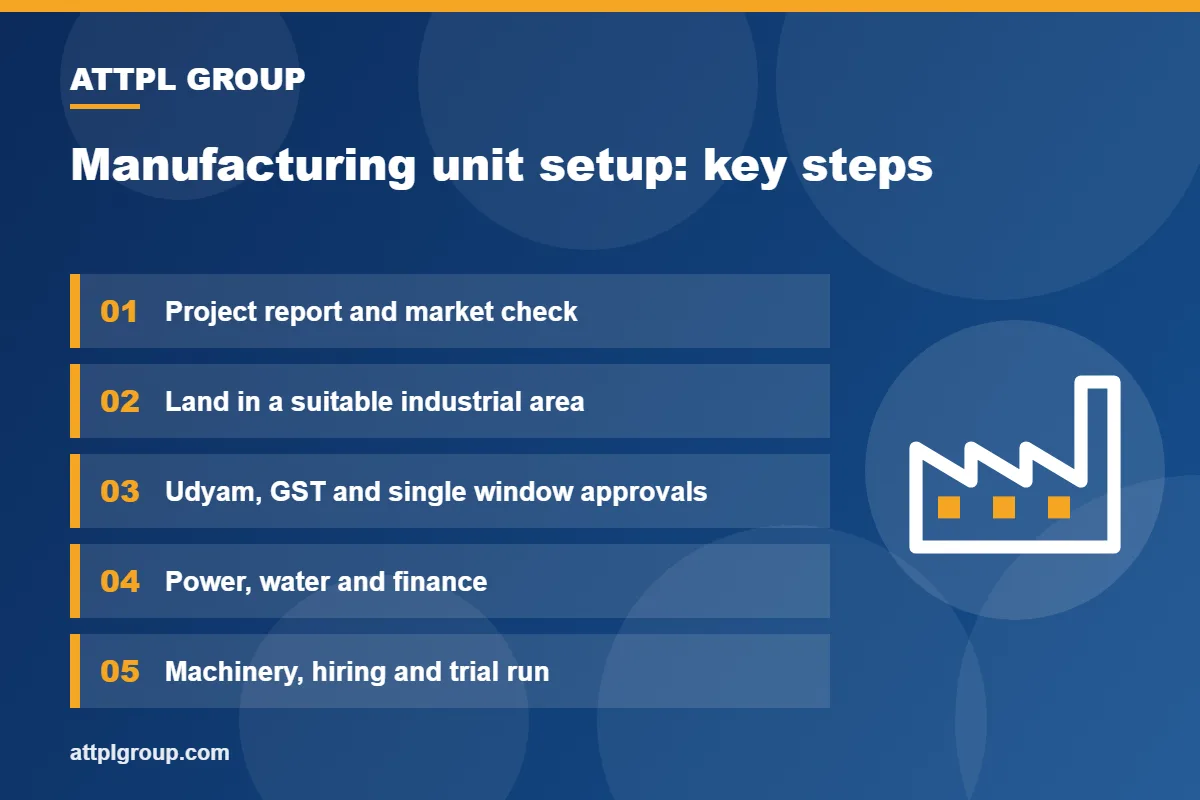
- DPR with realistic capacity and cash flow
- Land in a suitable industrial area
- Entity, PAN, Udyam and GST
- Single window application: building plan, fire, pollution consent, factory licence
- Power and water connection
- Term loan and working capital
- Machinery, hiring, training and trial run
Frequently asked questions
How long does it take to set up a small factory in Rajasthan?
It depends on the industry and site. A small unit in a ready industrial area can often start within a few months, while units needing land conversion or strict pollution consent take longer.
Is Udyam registration compulsory?
It is not a licence to operate, but it is needed to claim MSME benefits such as priority lending and many government schemes, so most small manufacturers register.
Which pollution consent do I need?
Most units need Consent to Establish before construction and Consent to Operate before production. The category of your industry decides the conditions and validity.
Plan your project with ATTPL Group
ATTPL Group brings finance, solar, infrastructure and technology services under one roof in Jaipur. Read about ATTPL Group, explore more guides on our blog, or contact our team to discuss your manufacturing project.