GST Tax Invoice Checklist: What a Small Business Invoice Should Contain
By ATTPL Group · · 5 min read
An invoice is more than a bill. It is the document that proves a sale, supports your customer’s claim for input tax credit, and forms the base of your own GST return. A small mistake on an invoice can lead to a rejected credit, a mismatch in returns or an awkward call from a customer’s accountant. This checklist explains what a GST tax invoice normally contains and how to build habits that keep errors out.
1. Know which document you are issuing
Under GST a registered supplier issues different documents for different situations: a tax invoice for taxable supplies, a bill of supply when the supplier does not charge tax (for example under the composition scheme or for exempt goods), and credit and debit notes to correct an earlier invoice. Using the wrong document is a common beginner error, so confirm your registration type with your tax professional before you print any stationery.
2. The details a tax invoice usually carries
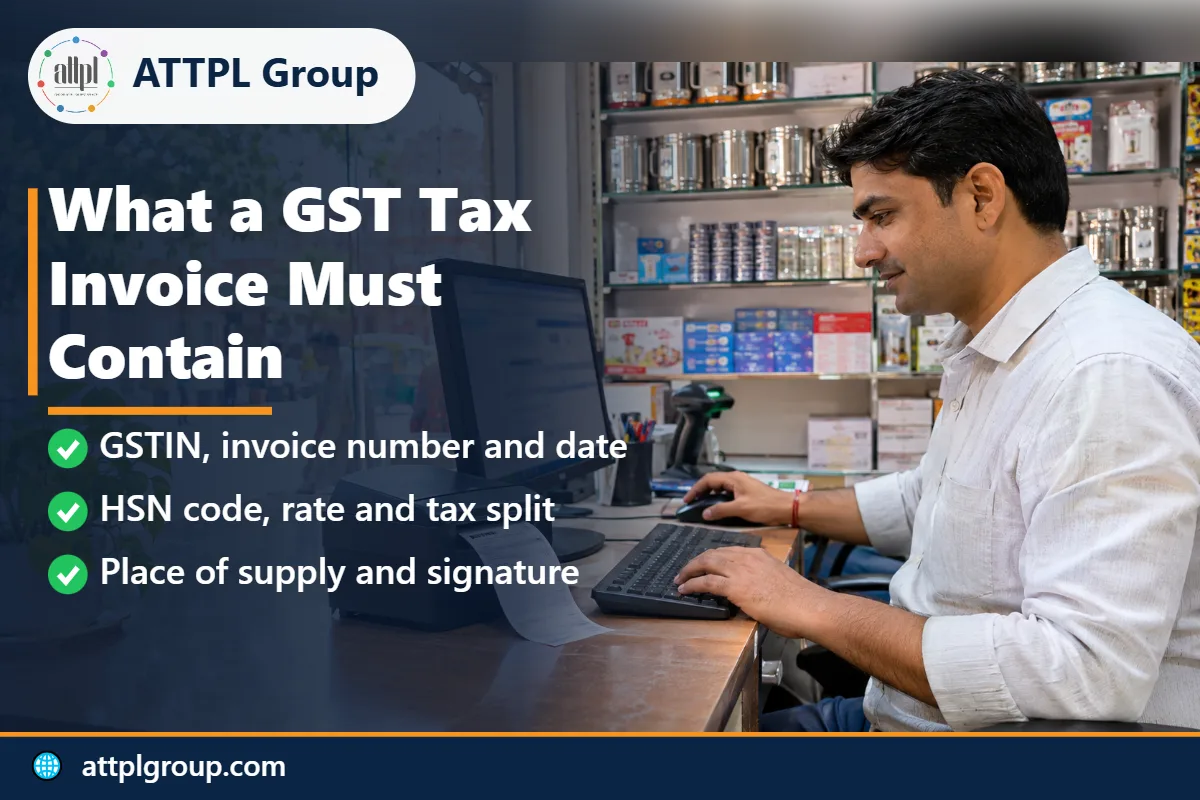
- Your name, address and GSTIN, and the name, address and GSTIN of the buyer where the buyer is registered
- A unique invoice number, in a consecutive series, and the date of issue
- A description of the goods or services, with the HSN code for goods or the SAC code for services where required
- Quantity and unit for goods, and the taxable value after any discount
- The rate and amount of CGST and SGST, or of IGST, shown separately
- The place of supply, and the state name and code where the supply crosses a state border
- The total invoice value, usually also in words
- Your signature or digital signature, and a note if tax is payable on reverse charge
The exact list, the rules on when the HSN or SAC code is mandatory and the time limit for issuing an invoice are set by the GST law and notifications, and they change from time to time. Always check the current rules on the official GST portal or with your tax professional.
3. Get the tax type right: CGST and SGST or IGST
If the supplier and the place of supply are in the same state, the tax is normally split into CGST and SGST. If they are in different states, IGST applies. The place of supply rules for services can be less obvious than for goods, so when a service is delivered online or to a customer in another state, check the rule instead of assuming. A wrong tax type does not only look untidy; it can block the buyer’s credit.
4. Number and date invoices in order
Use a single numbering system per financial year, with no gaps and no duplicates. If you issue invoices from more than one branch or billing counter, either keep separate series with a clear prefix or use one shared system. Do not reuse the number of a cancelled invoice. Record the reason for cancellation and issue a fresh number for the corrected one.
5. Handle corrections the proper way
When you find a mistake after the invoice has gone out, do not overwrite the old one. Depending on the case, you issue a credit note to reduce the value or a debit note to increase it, and report it in your returns as the law requires. Keep a note on the file explaining what changed and why. Communicate with the customer at the same time, so that their books match yours.
6. Check the buyer’s details before you bill
Ask for the buyer’s GSTIN in writing and verify it on the official portal before issuing the invoice. Confirm the legal name, because a trade name will not always match. For retail customers who are not registered, the rules are different, so follow the current provisions on invoices to unregistered buyers. Good record keeping begins at the counter, and our article on digital transformation for traditional businesses shows how to move from paper files to records that can be found years later.
7. Build a short weekly routine
- Match invoices issued with the sales ledger.
- Look for missing numbers and explain each one.
- Check that the tax rates used match the item master.
- Compare totals with what your accountant will file.
- Save digital copies in a folder arranged by month.
A weekly check takes a short time and prevents the big end-of-month cleanup. If you are new to registrations and licences, read our checklist for starting a business in Jaipur to see where GST fits among the other basic requirements.
8. Use software wisely
Billing software reduces typing mistakes and keeps numbering consistent, but it is only as good as the data entered. Set up the item list once with the correct HSN or SAC codes and tax rates, restrict who can edit old invoices, and take regular backups. Where your turnover crosses the threshold notified for e-invoicing, you will need to follow that system as well, so ask your tax professional when this applies to you. Dealing with suppliers is the other half of the picture: before you accept their invoices, apply the checks in our vendor due diligence checklist, so that the credit you claim is on firm ground.
Common mistakes to avoid
- Issuing handwritten invoices without a proper series
- Leaving out the buyer’s GSTIN on a business sale
- Using an old tax rate after a change
- Combining several customers in a single invoice
- Deleting a cancelled invoice instead of recording it
Need help with registrations, billing set-up or business planning? Call ATTPL Group toll-free on 1800 890 0815.
Disclaimer: This article is general information, not tax or legal advice. GST rules, rates and notifications change, so confirm the current position with the GST portal or a qualified tax professional.